Venusville – Prologue Review: Building a City in the Clouds of Venus
 Shaun M Jooste
Venusville - Prologue Review | Exciting 2026 Game Review
Venusville - Prologue review explores its story, floating city gameplay, visuals and atmospheric Venus setting.
Operating System: Windows 11
Application Category: Game
4
There are plenty of city builders that ask us to transform empty land into sprawling settlements, but Venusville – Prologue immediately has one considerable advantage when it comes to standing out: there isn’t any land.
Developed by Orbit Start Studios and published by PlayWay S.A., Venusville – Prologue takes the familiar concepts of resource management, construction and automation and transports them into the hostile atmosphere of Venus. Instead of establishing another settlement on Mars or building comfortably on an alien world’s surface, you’re responsible for a robotic platform floating among the clouds.
It’s an intriguing premise, particularly because maintaining the platform itself becomes part of the challenge.
Released on 5 August 2026 as a free standalone introduction to the upcoming Venusville, the Prologue isn’t intended to represent the scale of the eventual game. Instead, it introduces several of its defining systems while setting up the larger story.
After spending time among the sulphuric clouds, robots and precariously balanced machinery, it’s easy to see why the concept has potential.
Story Review: Something Is Waiting in the Clouds
Humanity hasn’t arrived on Venus yet.
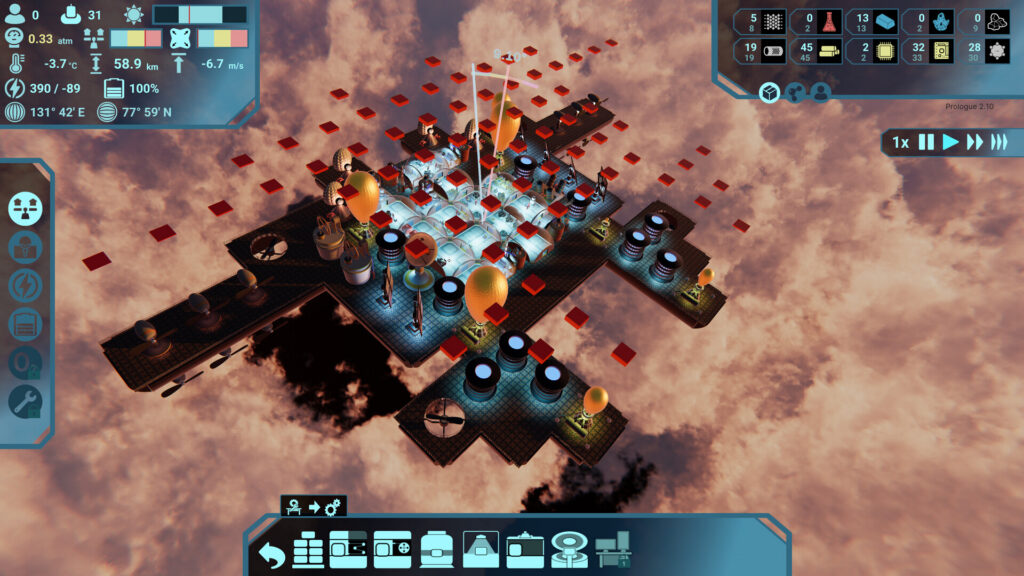
Instead, Venusville – Prologue places you in command of Platform 17, an autonomous corporate test mission operating within the planet’s polar atmosphere. Robots are doing the dangerous work while the mission determines whether the technology required for eventual human colonisation actually works.
That conveniently explains why there aren’t colonists wandering around demanding food, accommodation and entertainment.
Your initial objective appears straightforward: establish infrastructure, gather resources, generate power and keep the platform operational.
However, there’s something else happening within Venus’s clouds.
Platform 17 has been sent towards the planet’s enormous polar cyclone to investigate a mysterious anomaly detected from orbit. As the mission progresses, strange signals begin appearing, gradually introducing a mystery behind all the machinery and resource management.
It’s a clever narrative decision.
City builders don’t necessarily need elaborate stories, but the anomaly gives Venusville – Prologue something pulling you forward beyond simply unlocking the next structure. There is a reason you’re travelling through this environment and scanning Venus rather than indefinitely expanding a floating factory.
The Prologue ultimately serves as the final platform test before humans are sent to Venus, establishing a narrative bridge towards the full game.
It doesn’t reveal everything — nor should it.
Instead, it provides enough mystery to make us curious about what humanity might discover when the real colonisation begins.
Gameplay Review: Keeping an Entire City in the Sky
This is where Venusville – Prologue becomes considerably more interesting.
At its heart, we’re still dealing with familiar city-builder and automation concepts. Resources need collecting. Materials need processing. Power needs generating. Buildings need constructing.
The difference is that your city can effectively fall out of the sky.
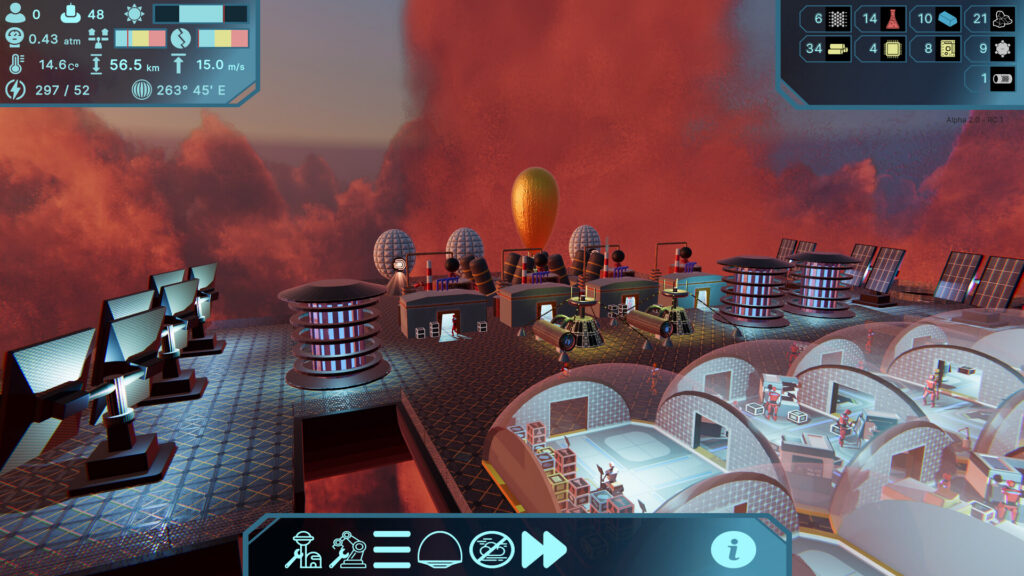
Buoyancy and weight distribution are central mechanics. Structures including batteries, solar panels, Stirling engines and vertical engines affect your floating platform, meaning expansion isn’t simply a question of whether you have enough resources.
You need to consider where you’re putting everything.
An unbalanced platform can tilt or descend towards the increasingly hostile pressure and temperatures below. That introduces a physical consideration absent from most traditional city builders. Every expansion potentially changes the stability of the structure supporting your entire operation.
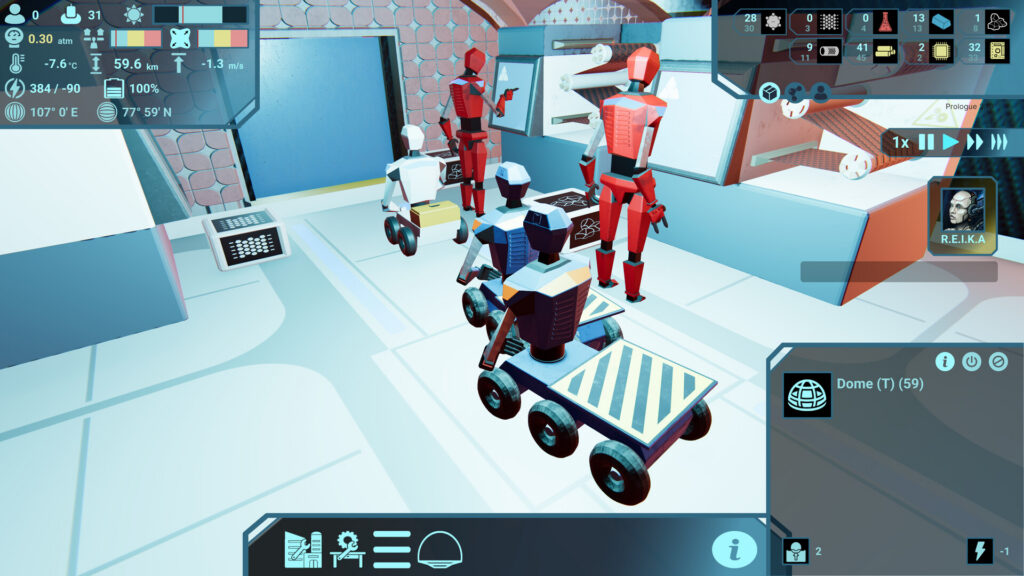
Your robotic workforce handles much of the activity. Different machines perform specialised jobs, including construction, engineering, transportation and resource processing. They need charging infrastructure and maintenance, creating another layer within the production network.
Then there’s Venus itself.
Atmospheric gases become resources that can eventually be processed into materials such as:
- Sulphur-based plastics
- Carbon materials
- Chemicals
- Metals
- Graphene
- Nanotubes
- Electronics
- Diamond-based computer components
That progression gives the production chains an appropriately futuristic identity instead of simply disguising familiar wood-and-stone crafting systems with science-fiction textures.
Power management is similarly connected to the environment. Solar power provides one option, while Stirling engines exploit temperature differences associated with altitude.
Eventually, exploration becomes important as well. Scanner stations reveal information across the polar region while the platform can navigate towards resources, hazards and anomalies.
Acid clouds, storms, pressure and temperature changes mean Venus isn’t merely a pretty background either. The planet actively influences how you operate.
There are rough edges. Some community discussion following release has already mentioned tutorial progression problems and unsupported display resolutions, which suggests further polishing may be required.
Nevertheless, this is precisely what a Prologue should accomplish.
It teaches us enough of the underlying systems to understand what makes the eventual game different without attempting to cram the complete colony simulation into a short introduction.
Audio and Visual Review: A Beautifully Hostile Venus
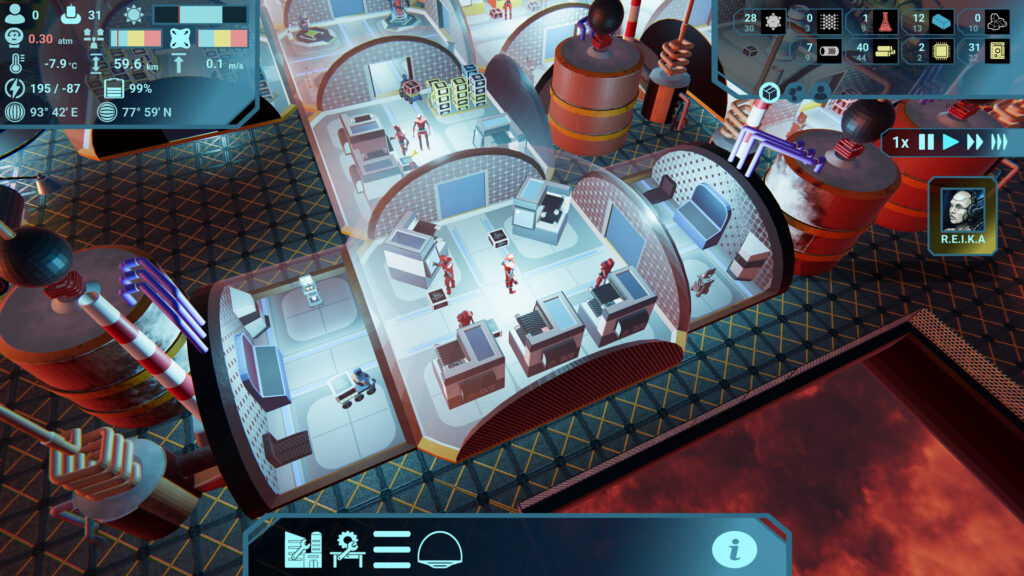
Visually, Venusville – Prologue wisely doesn’t attempt photorealism.
The stylised presentation works exceptionally well for a management game where readability matters. Structures, machinery and robotic units need to remain identifiable while you’re simultaneously watching production, energy and platform stability.
Meanwhile, Venus provides an atmospheric backdrop unlike the landscapes typically associated with colony builders.
You’re suspended within layers of alien clouds rather than staring across another rocky horizon. The enormous planet surrounding the platform reinforces the impression that this little collection of machinery is remarkably insignificant compared with the environment keeping it aloft.
There’s also something satisfying about watching the platform gradually transform.
What begins as a functional technological outpost develops into an increasingly complicated floating industrial structure. Because placement influences balance, the appearance of your platform also becomes a visual record of the decisions you’ve made.
The interface similarly has considerable information to communicate. Power, resources, robots, environmental conditions and platform stability all compete for your attention. There is inevitably some learning involved, but the Prologue’s smaller scale provides a sensible environment for becoming accustomed to these systems.
Audio is considerably more restrained, allowing the machinery and atmosphere to establish the science-fiction mood without constantly demanding attention.
One particularly interesting element is R.E.I.K.A, the AI companion. Orbit Start Studios openly states that R.E.I.K.A’s voice, along with the end dialogue, uses AI text-to-speech technology, while the game’s art, code, design and writing were created by the developer.
The resulting presentation fits the concept of an automated mission surprisingly well. You’re operating machinery in an environment where humans haven’t yet arrived, so the somewhat artificial nature of an AI voice isn’t particularly out of place.
Final Verdict: A Promising First Flight
Venusville – Prologue shouldn’t be approached expecting dozens of hours of city building.
Orbit Start Studios describes a straightforward run through its core content as approximately an hour, although experimenting with construction and the underlying systems can extend that considerably.
That’s enough. The Prologue has one job: demonstrate why we should care about the upcoming Venusville. And it succeeds.
The combination of resource management, automation and city construction would already provide a familiar foundation, but buoyancy changes the equation. Building a larger settlement isn’t automatically better when every new structure adds another consideration to the physical stability of your platform.
Add atmospheric resource extraction, robotic workers, environmental hazards, planetary exploration and the mystery surrounding the polar anomaly, and Venusville starts developing an identity beyond simply being another science-fiction colony simulator.
There are areas that could use refinement, particularly some technical and tutorial issues appearing in early player feedback. The short duration also means several systems only have enough time to introduce themselves before the Prologue reaches its destination.
However, that’s almost the point. This isn’t humanity’s Venusian civilisation. It’s the experiment determining whether that civilisation can exist.
For a free introduction to an upcoming game, Venusville – Prologue provides enough interesting ideas to make the clouds of Venus worth another visit when the full colony finally arrives.
If you enjoyed this review, be sure to check out our other reviews!