Celeris: The Streamwalker Issue #1 Review – The Bomb and the Wormhole
 Shaun M Jooste
Celeris: The Streamwalker Issue #1 Review – Exciting Comic!

FAB Comics introduces a promising superhero in Celeris: The Streamwalker. Our review explores its striking artwork, compelling origins and visual storytelling.
URL: https://globalcomix.com/c/celeris-the-streamwalker
Author: Tansheet Ali
3.8
Independent comic book publishers have the opportunity to introduce readers to original characters, unfamiliar worlds and stories that might otherwise struggle to find a place in mainstream superhero fiction. FAB Comics enters this territory with Celeris: The Streamwalker, a science-fiction superhero adventure that combines human tragedy with futuristic technology and interdimensional travel.
Created and written by Tansheet Ali, with art direction by FAB Comics, the first issue, The Bomb and the Wormhole, introduces Aariz Qadir, an ordinary young man whose courageous actions during a devastating attack change his life forever.
Celenic Earth Publications recently had the pleasure of showcasing the comic during a Twitch livestream with FAB Comics. During our discussion, the creators explained that the story was inspired by the situation in Palestine, providing important context for the opening scenes and the circumstances surrounding Aariz’s transformation.
FAB Comics also provided us with a digital copy for review. Having now read the first issue, I found myself impressed by its futuristic artwork, intrigued by its central character and interested in discovering where the story might lead. However, there are also aspects of the visual storytelling that I believe could benefit from further development.
Let’s take a closer look at what makes Celeris: The Streamwalker worth reading and where future issues could improve.
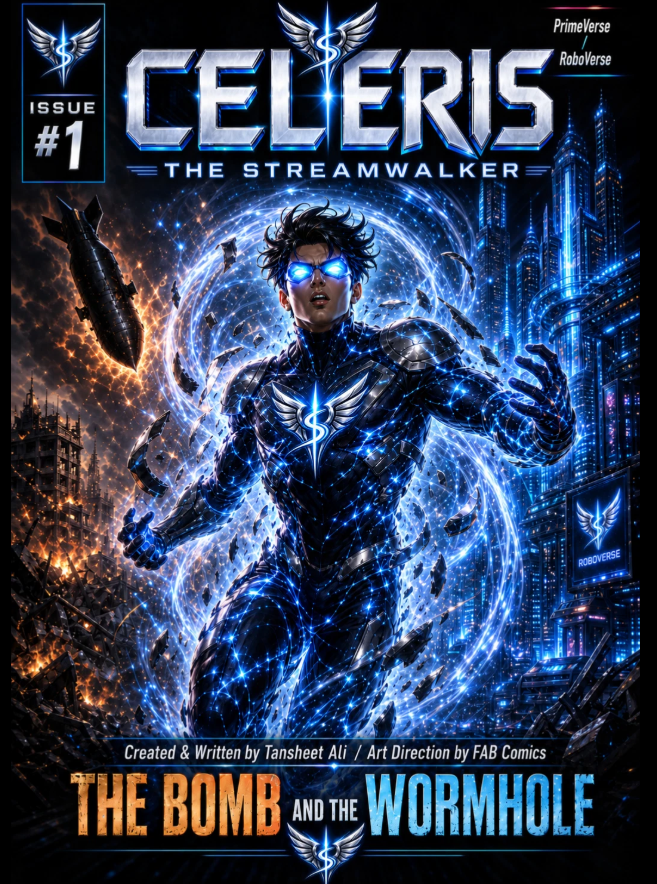
A Superhero Origin Inspired by Real-World Tragedy
The story begins in Gaza, where Aariz Qadir finds himself surrounded by the destruction of war. Buildings are damaged, civilians are in danger, and an approaching bomb threatens to claim more innocent lives.
Rather than attempting to escape alone, Aariz desperately warns the people around him, encouraging them to find shelter before the bomb strikes.
I appreciated this introduction because it establishes Aariz’s character before he receives any extraordinary abilities. He doesn’t need advanced technology or superhuman strength to demonstrate courage. His willingness to protect others already makes him heroic.
Knowing that FAB Comics drew inspiration from the situation in Palestine adds another dimension to the opening sequence. The creators have chosen to begin their superhero story in circumstances inspired by genuine human suffering rather than relying entirely on a fictional disaster.
The result is an origin that immediately establishes compassion and sacrifice as important elements of the protagonist’s identity.
However, the situation takes an unexpected turn when a mysterious wormhole appears during the attack. Aariz is pulled away from Earth and transported into an entirely different environment known as RoboVerse.
What begins as a story about survival quickly transforms into an adventure involving advanced artificial intelligence, robotic security forces and extraordinary technological possibilities.
The transition is dramatic, and the contrast between the two settings creates an interesting foundation for the series.
Entering the Technological World of RoboVerse

One of the strongest aspects of Celeris: The Streamwalker is the introduction of RoboVerse.
After arriving through the wormhole, Aariz discovers an unfamiliar world dominated by enormous mechanical structures, glowing energy systems and sophisticated machines. It is immediately apparent that he has entered a civilisation operating far beyond the technology he knows.
Unfortunately, his arrival attracts unwanted attention. The robotic security forces identify Aariz as an anomaly, and their attempts to assess and contain him create much of the tension during the middle portion of the issue.
As the machines investigate his presence, they discover that something unusual has happened to him during his journey through the wormhole. His energy signature suggests that he is no longer an ordinary human visitor.
This mystery eventually leads to an encounter with advanced artificial intelligence and a remarkable transformation involving nanotechnology. By the end of the issue, Aariz has become Celeris, the Streamwalker.
I enjoyed the concept behind this transformation. The combination of interdimensional travel, advanced machines and technological reconstruction provides several possibilities for future stories.
RoboVerse itself also deserves further exploration. The first issue introduces an impressive technological environment, but there is still much we don’t know about its inhabitants, society and underlying systems.
That sense of mystery is one of the reasons I would be interested in reading the next instalment.
Impressive Artwork and Futuristic Environments
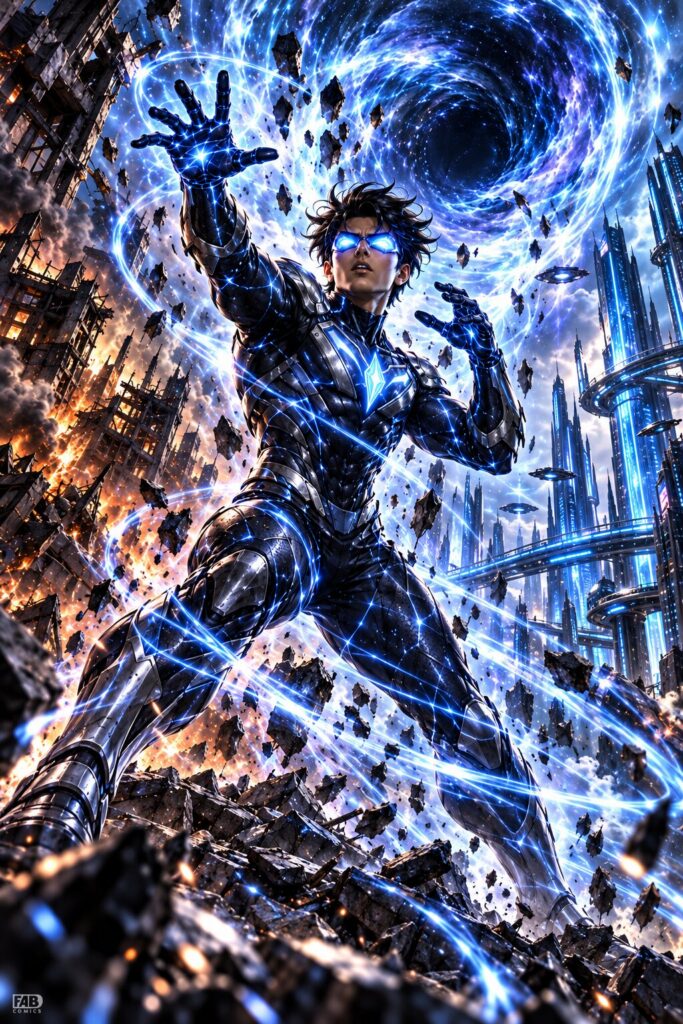
The artwork is undoubtedly one of the comic’s greatest strengths.
FAB Comics has created a distinctive science-fiction aesthetic dominated by metallic structures, brilliant blue energy effects and elaborate futuristic environments.
The opening scenes in Gaza establish a darker atmosphere, with damaged buildings, smoke and explosions creating a sense of immediate danger. When the wormhole appears, the visual presentation changes dramatically as luminous energy surrounds Aariz and carries him into another dimension.
I particularly enjoyed the illustrations depicting RoboVerse for the first time.
The towering structures and mechanical environments create an impressive sense of scale, while the glowing technology gives the setting a recognisable identity. There is plenty of detail to appreciate, especially when viewing the illustrations on a larger screen.
The robotic security forces also contribute to the atmosphere. Their mechanical designs and glowing sensors make them appear intimidating, reinforcing the idea that Aariz is surrounded by technology he doesn’t understand.
Another highlight is the transformation sequence towards the end of the issue. Watching the advanced technology reconstruct Aariz into his new form provides a satisfying visual moment and establishes the appearance of the superhero readers will follow in future instalments.
However, while I enjoyed the individual illustrations, I noticed that the visual presentation became somewhat repetitive as the story progressed. This brings me to my main part of my review of Celeris: The Streamwalker #1.
Panel Composition and Visual Storytelling
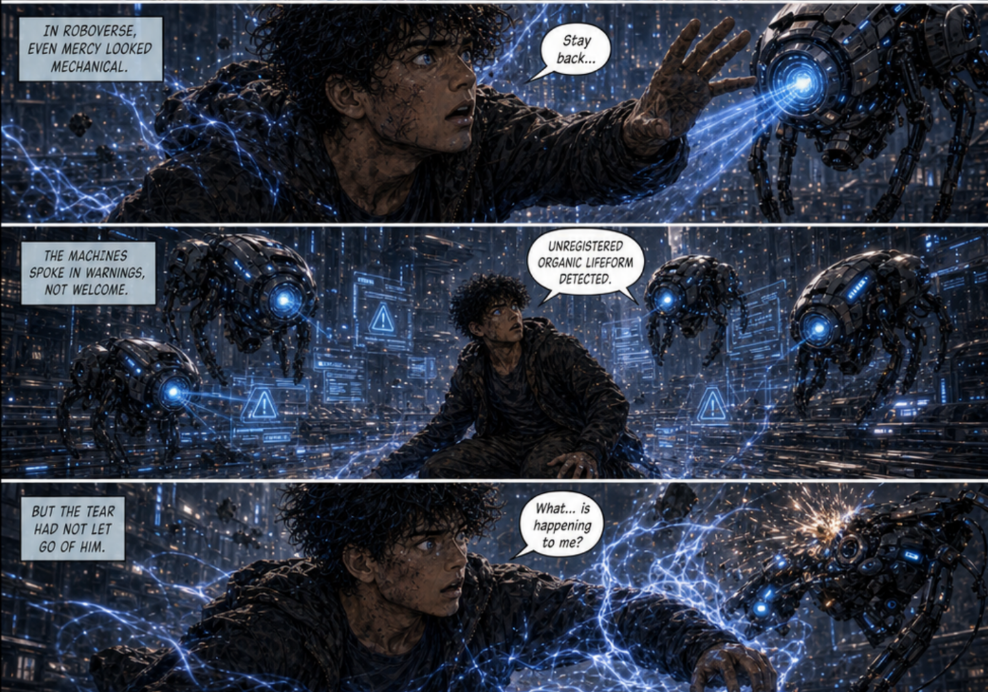
Although the individual illustrations are impressive, I believe the overall page composition is an area where Celeris: The Streamwalker could improve.
Most pages feature similarly sized horizontal panels arranged directly above one another. There is relatively little variation in the layout, with the illustrations generally occupying the available space without additional background layers or more experimental arrangements.
There is nothing inherently wrong with this approach. Horizontal panels can create a cinematic reading experience, particularly when depicting action sequences or expansive environments.
However, the repeated arrangements eventually become noticeable.
As I continued reading, I found that some of the illustrations began to blend into one another. The consistent colour palette, similar perspectives and repeated panel dimensions occasionally made it difficult for individual moments to stand out visually.
This was particularly apparent during sequences involving Aariz and the robotic security forces. Although the story continued to progress, several illustrations shared similar compositions, reducing the sense of movement between panels.
I would have appreciated greater experimentation with panel sizes, perspectives and overall page design.
For example, an important moment such as Aariz’s first view of RoboVerse could benefit from a larger illustration that interrupts the established layout. Similarly, varying the perspectives during confrontations could create a stronger sense of action and urgency.
These are suggestions rather than requirements. Every comic publisher develops its own visual identity, and there is no single correct approach to page composition.
Nevertheless, I believe greater variety would help FAB Comics showcase its artwork more effectively and make the reading experience more dynamic.
Narration, Dialogue and Understanding the Story
Another aspect worth discussing is the comic’s use of narration.
Personally, I tend to prefer stories where characters communicate much of the plot through their conversations and interactions. However, narration boxes are an established part of comic-book storytelling, and their effectiveness depends on how well they support the illustrations.
In Celeris: The Streamwalker, the narration frequently appears alongside the artwork, explaining the events unfolding on the page and providing context for the unfamiliar technology and environments. I found this approach helpful!
Despite the rapid progression from Gaza to RoboVerse and the introduction of several science-fiction concepts, I never struggled to understand what was happening. The narration provides enough information to follow Aariz’s journey without requiring extensive knowledge of the world or its technology.
This is particularly important in an introductory issue, where readers are encountering unfamiliar characters, locations and terminology for the first time.
Although I would welcome more character-driven dialogue in future issues, I don’t consider the current narration style a weakness. On the contrary, it helps maintain clarity throughout the story.
There is an opportunity to refine the balance between narration and dialogue as the series progresses, particularly once Aariz begins interacting with other characters and developing relationships within RoboVerse.
For now, the storytelling remains accessible and understandable, which is an important achievement for a new science-fiction series.
Aariz Qadir – A Character I Want to Know Better
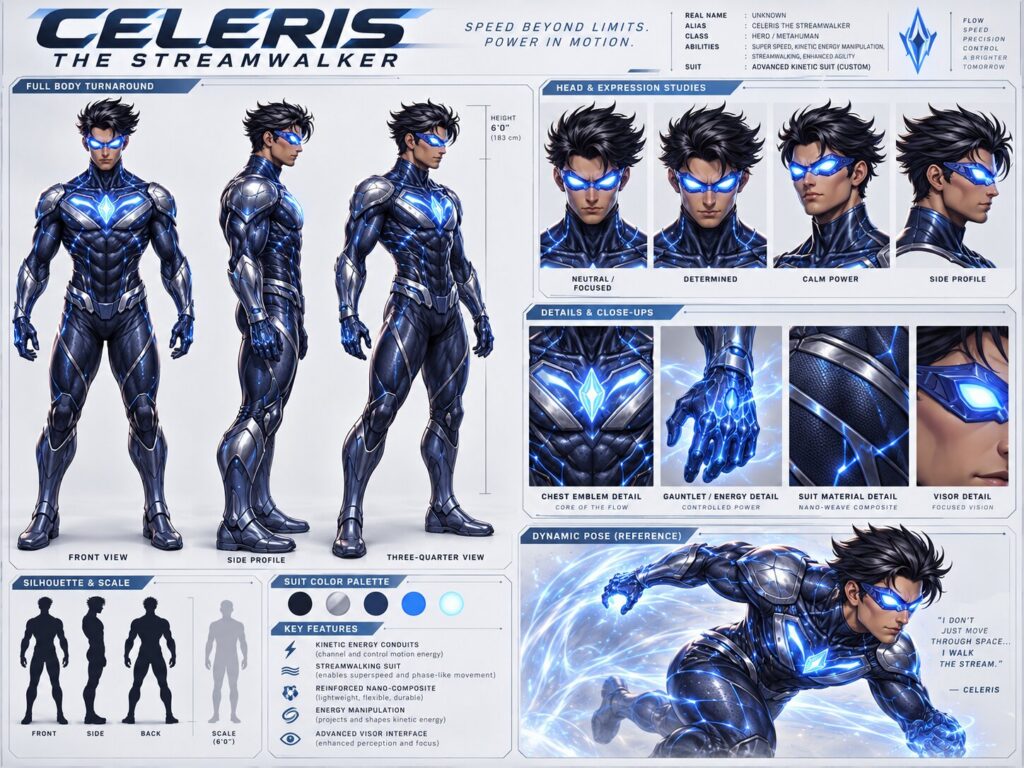
One of the questions I considered while reading Celeris was whether the first issue provides enough information about its protagonist.
We learn that Aariz is courageous and compassionate. His actions during the opening sequence establish someone willing to risk his own safety to protect innocent people.
However, we discover relatively little about his personal life, relationships or ambitions before the wormhole transports him into RoboVerse… for now.
The story also moves quickly through several significant events. Within a short period, Aariz experiences the horrors of war, survives an extraordinary journey between worlds, encounters hostile machines and undergoes a dramatic transformation.
I would have appreciated more opportunities to experience his emotional reactions to these events. How does he feel about being separated from Earth? What does he remember about the people he tried to save? How will his experiences influence the decisions he makes with his new abilities?
These are questions I hope future issues will explore. Interestingly, though, I didn’t finish the comic feeling disconnected from Aariz. Quite the opposite!
Despite the limited character development, I genuinely wanted to learn more about him. His introduction establishes enough of his personality to make him appealing, while his transformation creates several intriguing possibilities.
That curiosity is an important strength.
An introductory issue doesn’t necessarily need to reveal everything about its protagonist. Sometimes its greatest achievement is encouraging readers to return for the next chapter. In that respect, Celeris: The Streamwalker succeeds.
A Digital-First Comic Book Experience
FAB Comics follows a digital-first publishing approach, and the review copy supplied to Celenic Earth Publications was provided in PDF format.
While I personally enjoy collecting physical comic books, I recognise the advantages digital publishing offers independent creators. Digital releases can make comics accessible to international audiences without the immediate printing, shipping and distribution challenges associated with physical editions.
For a publisher introducing original characters and developing a new fictional universe, this approach can be particularly practical. The absence of a physical edition has no negative impact on my review score.
I believe a comic should be assessed according to the quality of its storytelling, artwork and presentation rather than whether readers can purchase a printed copy. The digital format also suits much of the artwork in Celeris. The luminous energy effects and detailed futuristic environments look particularly impressive when viewed on a suitable screen.
There are some considerations for smaller devices, however. Certain narration boxes and detailed panels may require readers to zoom in to appreciate everything comfortably.
As FAB Comics continues developing its digital catalogue, optimising lettering and page layouts for different screen sizes could further improve accessibility.
Overall, though, the PDF provided an enjoyable reading experience and allowed me to appreciate the visual detail throughout the issue.
Final Verdict – 3.8/5 Stars
Celeris: The Streamwalker – Issue #1: The Bomb and the Wormhole is a promising introduction to an original science-fiction superhero series.
Tansheet Ali has created an interesting premise that begins with human compassion amid tragedy before expanding into a technologically advanced universe filled with possibilities.
The opening sequence establishes Aariz Qadir as someone whose heroic qualities exist long before he receives extraordinary abilities. Knowing that the creators drew inspiration from the situation in Palestine adds meaningful context to his origins and the circumstances surrounding his transformation.
FAB Comics also deserves recognition for its ambitious visual presentation. RoboVerse is an impressive environment, and the detailed mechanical structures, robotic characters and glowing energy effects create a distinctive science-fiction identity.
The narration effectively guides readers through the story, making the unfamiliar concepts and rapid developments easy to follow. However, I believe there is room for improvement in the visual storytelling.
The repeated horizontal panel layouts, similar compositions and consistent colour schemes occasionally cause the illustrations to blend together. Greater experimentation with page design and visual perspectives could help important moments stand out and improve the overall flow.
I would also welcome more opportunities to learn about Aariz as an individual, particularly his emotional response to the extraordinary circumstances that have changed his life. Despite these reservations, I finished the first issue wanting to discover more about the character and the world he now inhabits.
That is perhaps the strongest compliment I can give an introductory comic.
The preview for Issue #2, Trials of RoboVerse, suggests that Aariz’s journey is only beginning, and I am interested in seeing how FAB Comics develops both the protagonist and the technological universe surrounding him.
Celenic Earth Publications awards Celeris: The Streamwalker – Issue #1 a rating of 3.8 out of 5 stars.
It is a visually impressive superhero origin with an intriguing central character, effective narration and considerable potential for future development. While the panel composition could benefit from greater variety, the foundations are strong enough to make me look forward to the next issue.
Want Your Comic Book or Graphic Novel Reviewed?
Are you an independent comic book creator or graphic novelist looking for a professional review of your work?
Celenic Earth Publications welcomes comics and graphic novels for consideration through Celenic Comic Central. Our reviews aim to celebrate creative achievements while providing constructive, independent feedback that helps readers discover new stories and creators.
Whether you’re developing an original superhero universe, adapting a literary classic or exploring an entirely different genre, we’d love to discover what you’ve created.
Submit your comic book or graphic novel to Celenic Earth Publications for review consideration.