The Count of Monte Cristo Volume I: The Fall of Edmond Dantès Review
 Shaun M Jooste
The Count of Monte Cristo: Volume I - The Fall of Edmond Dantès

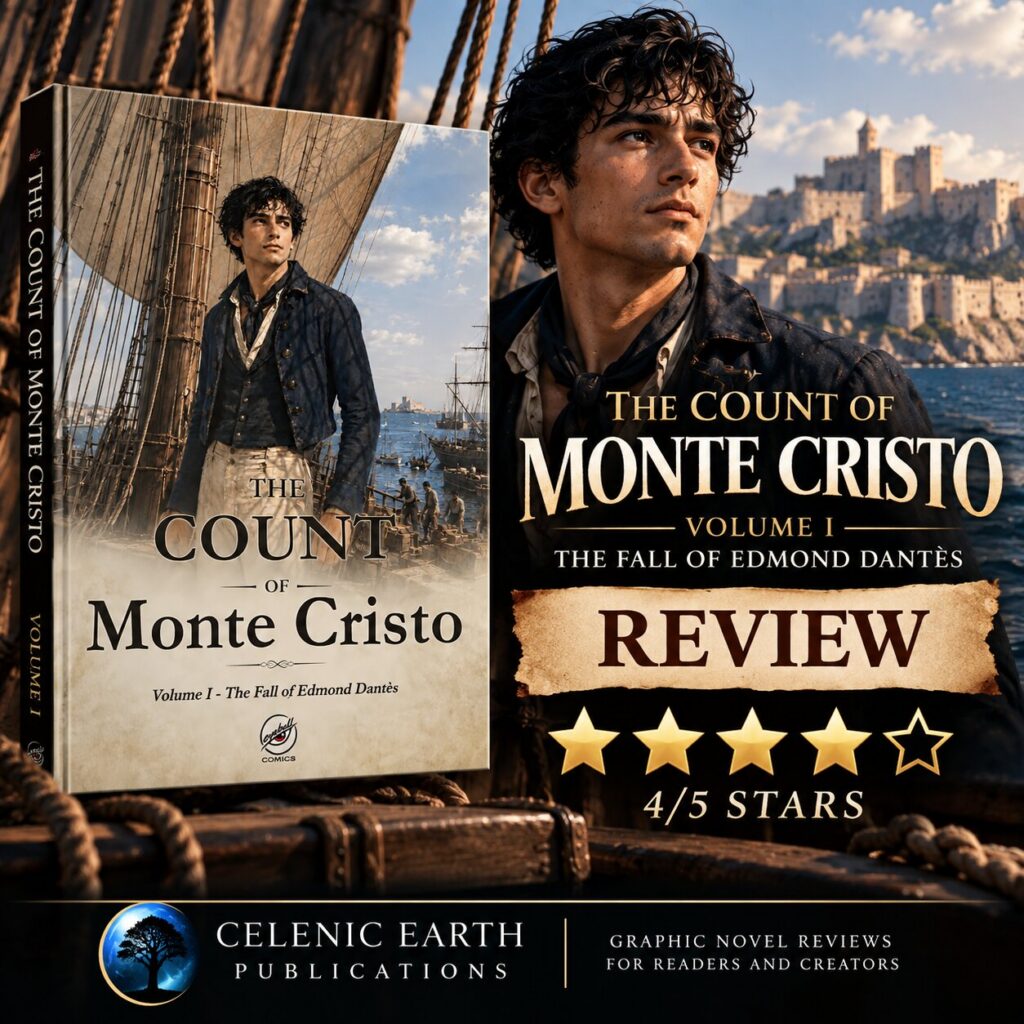
Ian Kirs delivers a visually striking and faithful adaptation of The Count of Monte Cristo, bringing Edmond Dantès’ downfall to life with cinematic flair. Despite some repetitive panels and darker print reproduction, Volume I earns a strong 4/5 stars.
URL: https://link.amazon/B0451icgf
Author: Ian Kirs
4
Few novels have endured quite like Alexandre Dumas’ The Count of Monte Cristo. Its story of betrayal, imprisonment, transformation and revenge has inspired adaptations across film, television and other media for generations. Ian Kirs of Eyeball Comics has now taken on the considerable challenge of adapting this literary classic into a planned twelve-volume graphic novel series, beginning with Volume I: The Fall of Edmond Dantès.
Having read the original novel and watched a film adaptation, I came into this review already familiar with Edmond Dantès and the devastating events that change the course of his life. For me, the biggest question was whether this new interpretation could remain recognisable as The Count of Monte Cristo while finding its own identity through the graphic novel format.
There is also an important modern element to this adaptation: it is AI-assisted, particularly in the creation of its visuals. Rather than hiding this aspect of the production, the book openly acknowledges the use of AI image-generation tools under human creative direction, as well as ChatGPT for editorial, language and production support. Ian Kirs is credited with the adaptation, art direction, design, editing and lettering. The_Count_of_Monte_Cristo This distinction is important. The question isn’t simply whether AI can generate attractive images, but whether a creator can direct those tools and transform the results into a coherent piece of sequential storytelling.
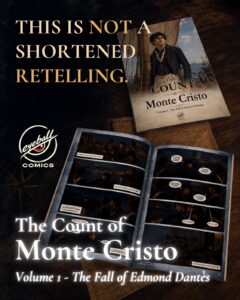
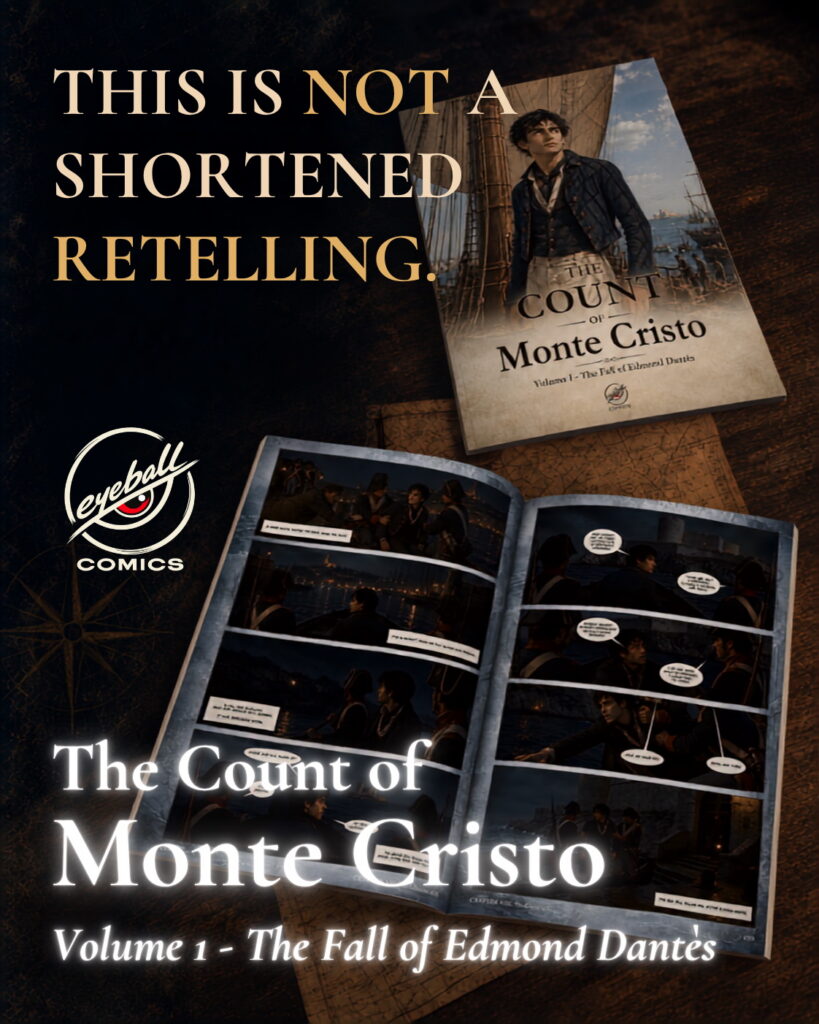
Ian was also kind enough to provide me with the digital PDF and arrange for a physical review copy to be printed and distributed to me through Amazon. Having both versions available gave me an excellent opportunity to compare the digital artwork with the finished physical product. As we’ll discuss later, there are some noticeable differences between the two, particularly when it comes to the reproduction of the graphic novel’s darker scenes.
Overall, The Fall of Edmond Dantès makes an ambitious and visually striking beginning to this adaptation. There are areas where I feel future volumes could improve, particularly in some of the panel choices and the reproduction of darker artwork in print. However, the most important compliment I can give Ian Kirs at the outset is a simple one: this still feels like The Count of Monte Cristo.
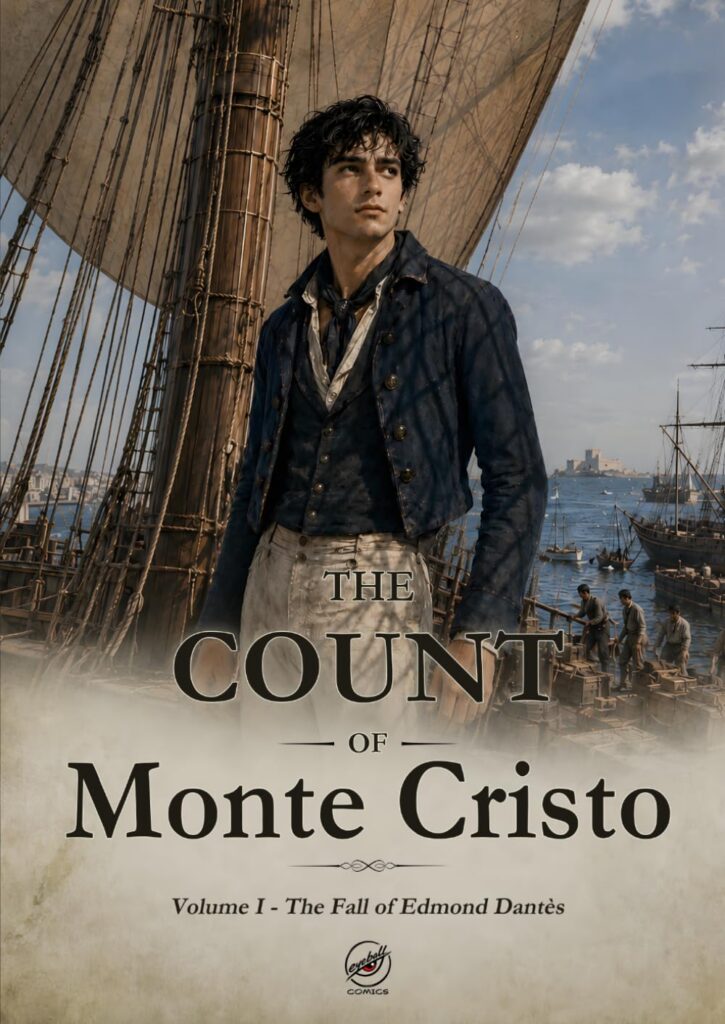
Table of Contents
Story and Adaptation
Adapting The Count of Monte Cristo into a graphic novel is no small undertaking. Alexandre Dumas’ story is enormous in scope, with numerous characters, political intrigues and interconnected storylines. Ian Kirs has wisely avoided attempting to squeeze everything into a single publication. Instead, this adaptation is planned across twelve volumes, giving the story considerably more room to develop.
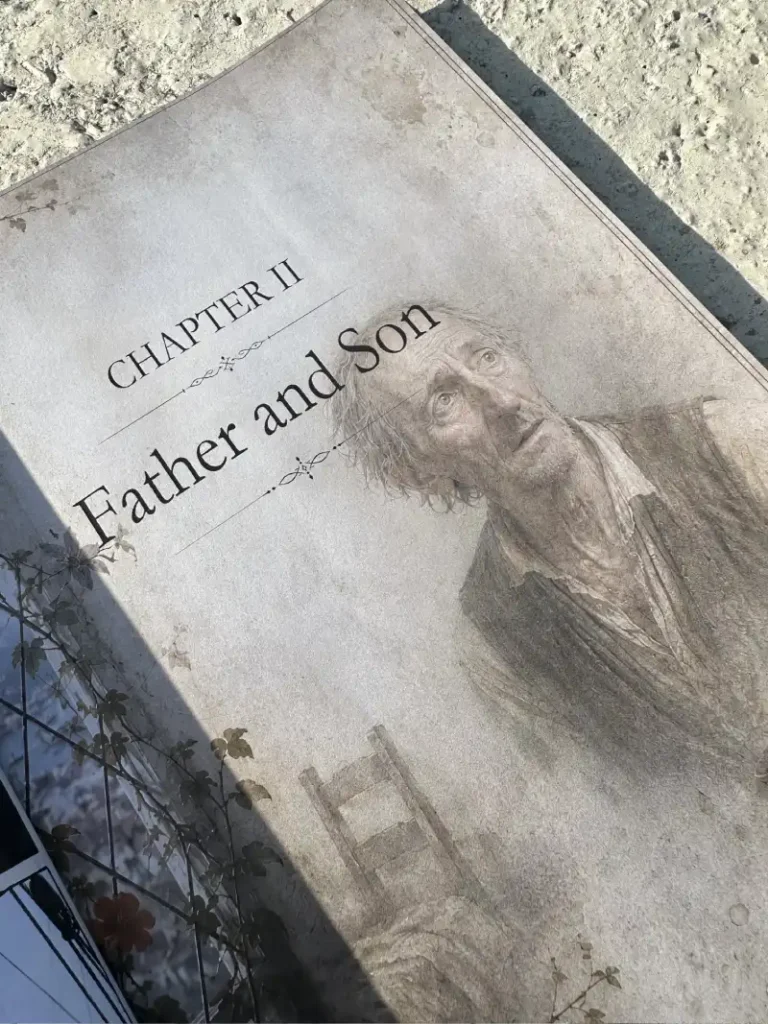
Volume I: The Fall of Edmond Dantès concentrates on exactly what its subtitle promises: the destruction of Edmond’s seemingly perfect future. Across eight chapters, we follow his return to Marseille aboard the Pharaon, his reunion with his father and Mercédès, the jealousy and conspiracy developing around him, his arrest, his examination by Villefort and ultimately his imprisonment in the Château d’If.
This is an effective place to divide the larger story. Edmond begins the volume as a young man with almost everything going his way. He has returned home safely, his professional prospects are improving, and he is preparing to marry the woman he loves. Meanwhile, the reader watches the conspiracy against him develop while Edmond remains largely unaware of the danger surrounding him.
Having previously read the novel, I was pleased with how recognisable the characters and major events remain in this adaptation. I have also seen the story adapted to film, and there were numerous moments throughout the graphic novel where the familiarity of The Count of Monte Cristo came through strongly. The graphic format naturally requires some condensation, but I never felt that Ian had stripped away the identity of Dumas’ story simply to move the plot along faster.
The progression towards Edmond’s arrest is particularly effective. We have already seen the jealousy surrounding his relationship with Mercédès and the conspiracy taking shape before the authorities suddenly arrive. From there, the mood of the volume changes dramatically. Edmond goes from celebrating his future to desperately trying to understand why that future is being taken away from him.
Villefort’s examination of Edmond is another important part of this first volume. It establishes just how completely Edmond has become trapped in circumstances he doesn’t understand. By the time he is taken to the Château d’If, the hopeful young sailor from the beginning of the story has effectively lost everything.
Ending Volume I with Edmond imprisoned is therefore an excellent narrative choice. The final pages leave him behind the imposing prison door before announcing the end of the volume. For newcomers, it provides a strong cliffhanger. For those of us who already know Edmond Dantès’ story, it carries another meaning entirely: the man who will eventually become the Count of Monte Cristo has not truly emerged yet.
As a first instalment in a much larger adaptation, The Fall of Edmond Dantès does what it needs to do. It introduces the important relationships, establishes the betrayal at the heart of Edmond’s downfall and leaves us at precisely the point where his life has been completely overturned. Most importantly for me as someone familiar with the source material, Ian Kirs’ adaptation feels respectful of the story I remember while still presenting it in a very different medium.
Visuals and AI-Assisted Artwork
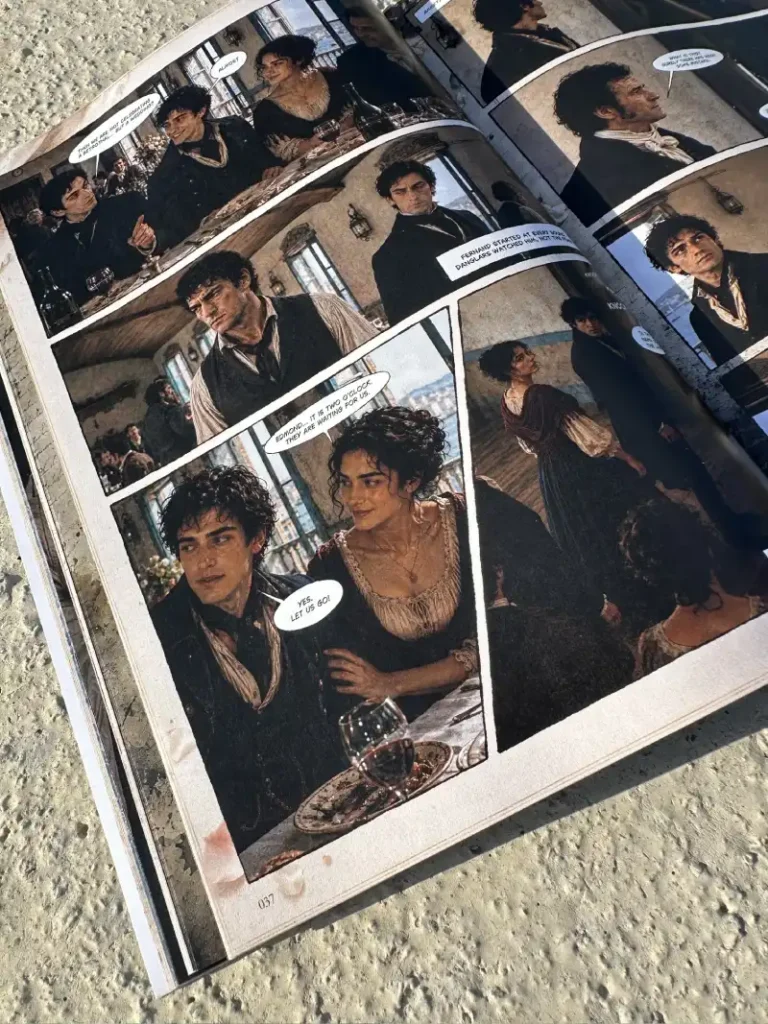
The visuals are undoubtedly one of the defining features of The Fall of Edmond Dantès. Rather than attempting to recreate the appearance of a traditional hand-drawn comic, Ian Kirs has opted for a cinematic, semi-realistic presentation. At times, the panels almost resemble stills taken from a lavish historical film, which feels particularly appropriate for a story such as The Count of Monte Cristo.
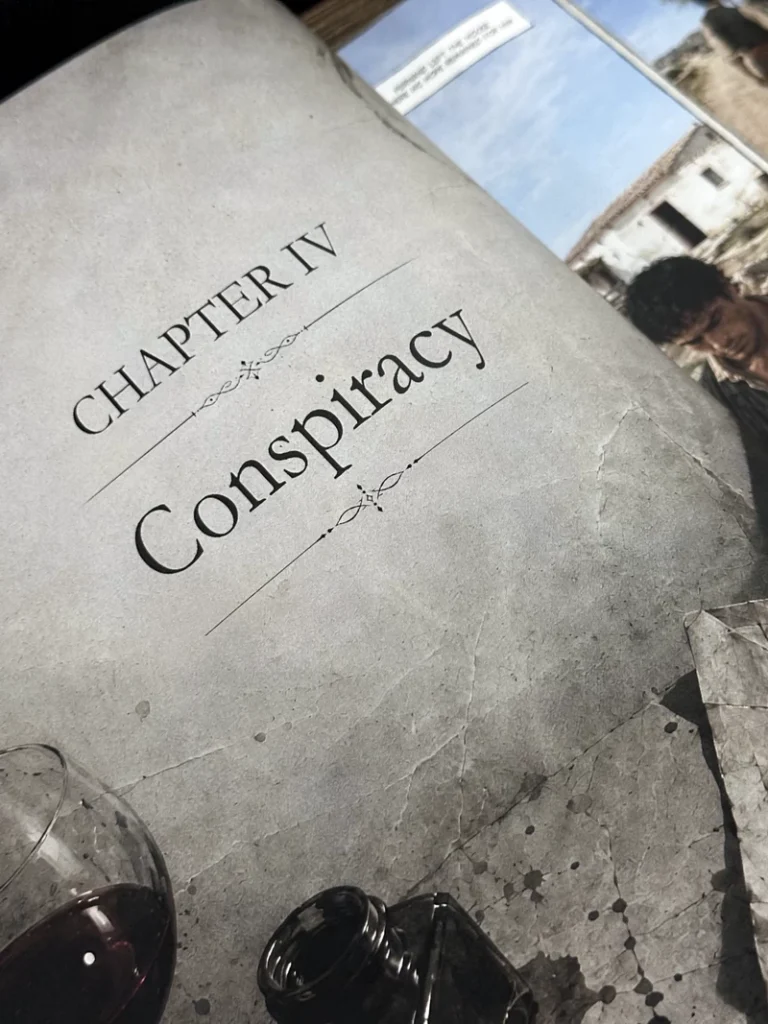
One of the strongest aspects is the atmosphere. The early scenes around Marseille are brighter and more inviting, helping to establish the optimism surrounding Edmond’s return aboard the Pharaon. As the conspiracy develops and Edmond’s circumstances deteriorate, the visual language becomes progressively darker. By the time we reach his examination and eventual imprisonment, cold blues, greys, shadows and imposing interiors have taken over much of the page.
Character consistency also deserves recognition. Maintaining recognisable characters across dozens of AI-assisted images is not necessarily an easy task, yet Edmond, Mercédès, Danglars, Fernand, Villefort and the other principal characters remain identifiable throughout the volume. There are occasional images where faces, expressions or poses carry some of the familiar characteristics of AI-generated artwork, but these moments rarely prevented me from recognising who I was looking at.
It is also important to separate AI image generation from the finished visual storytelling. The book openly acknowledges its use of AI tools, but Ian is responsible for the art direction, design, editing and lettering that turn those individual assets into completed pages. Looking through the volume, that human direction is evident in the choice of compositions, close-ups, establishing shots, panel arrangements and changing visual atmosphere.
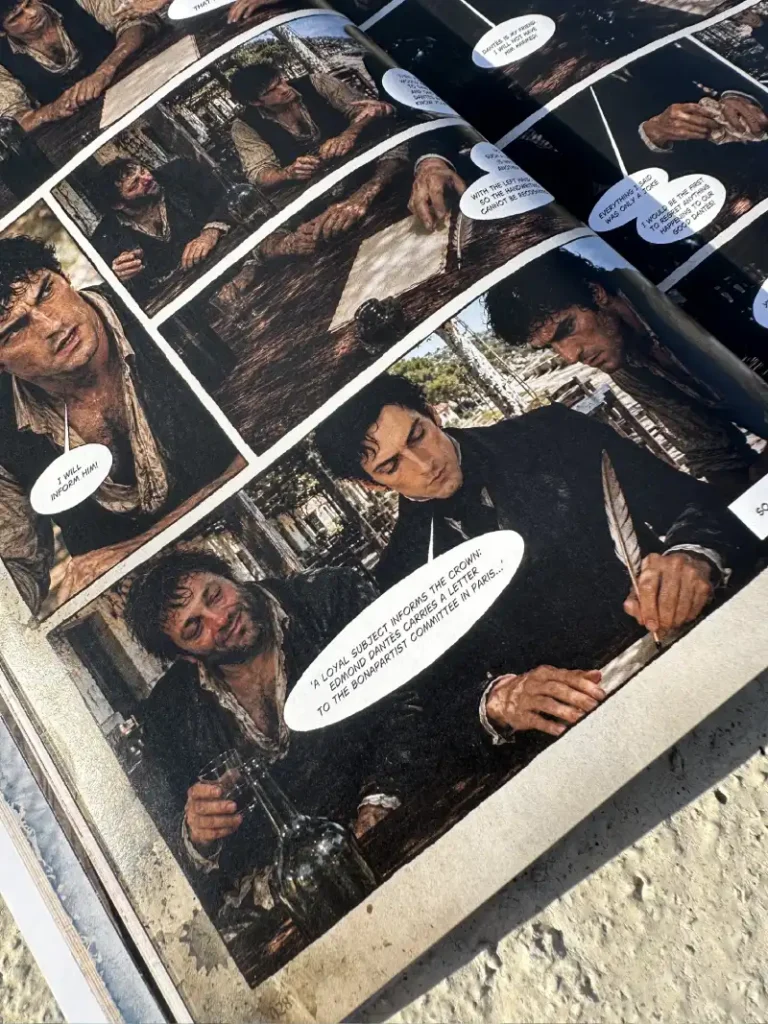
I particularly enjoyed how the page design itself sometimes reinforces the tone of a scene. During the conspiracy, the tavern sequences use distressed, earthy textures around the panels, complementing the increasingly unpleasant intentions of the men plotting against Edmond. Later, the examination and Château d’If sequences adopt colder and much darker surroundings, making the pages themselves feel increasingly oppressive.
That doesn’t mean every generated image works equally well. Some expressions can appear slightly posed or overly polished, while certain background elements naturally receive less attention than the principal characters. Occasionally, the photographic quality also creates the impression of looking at film stills rather than conventional comic-book artwork. However, I found that this became part of the graphic novel’s distinctive identity rather than something that consistently worked against it.
For me, the achievement isn’t that AI was capable of producing attractive individual images. It is that Ian Kirs has taken AI-assisted artwork and maintained a sufficiently coherent visual world across an entire volume. The locations, characters, costumes and changing atmosphere generally feel as though they belong to the same adaptation.
There are some areas where the selection and progression of individual frames could have been stronger, but that is less an issue with the artwork itself and more one of sequential storytelling. That deserves its own discussion.
Pacing, Panels and Sequential Storytelling
While the individual visuals are generally impressive, a graphic novel ultimately needs to do more than present a collection of attractive images. Each panel needs to contribute to the progression of the story, whether through action, emotion, dialogue or a change in perspective. This is one area where I feel The Fall of Edmond Dantès could benefit from some tighter editing.
For the most part, Ian Kirs varies the layouts effectively. Large establishing images introduce locations, close-ups draw attention to emotional reactions, and smaller panels allow conversations to unfold. There are also moments where allowing a particular image more space gives an important event additional dramatic weight. This helps prevent the volume from simply becoming a sequence of identically sized AI-assisted images.
However, there are occasional frames that feel unnecessarily similar to the ones immediately before or after them. In these instances, the dialogue may change slightly, but the composition, character positioning and narrative information remain almost identical. Rather than slowing the story deliberately for dramatic effect, some of these repetitions made me wonder whether the additional frame was necessary.
One of the clearest examples occurs during Edmond’s arrest. On page 38, the final frame has a bewildered Edmond asking, “Arrest me? For what?” Turn the page, and the opening frame on page 39 has him asking, “Why am I being arrested?” The two lines communicate essentially the same reaction, while very little has changed visually between the moments.
For me, one of those frames could easily have been removed or the second panel could have offered something substantially different. A reaction from another character, a different perspective on the arrest, or simply allowing the first question to carry into the next development would have kept the sequence moving without losing anything important.
Similar moments occur elsewhere, particularly during some of the longer conversations where consecutive panels use comparable character positions and camera angles. They aren’t frequent enough to damage the reading experience, but they occasionally interrupt what is otherwise strong visual pacing.
This is also why I view the issue as one of sequential editing rather than AI generation. Regardless of whether artwork is drawn by hand, photographed, digitally illustrated or generated with AI assistance, the final responsibility is deciding which frames make it onto the page. Every panel should ideally earn its place.
With twelve volumes planned, this is also an area where I would be interested to see the series evolve. Greater variation between consecutive frames and slightly more ruthless editing of repeated visual beats could make future volumes feel even more dynamic. The foundation is already there; sometimes, The Fall of Edmond Dantès simply needs to trust its strongest panels enough to let them speak for themselves.
Physical vs Digital
One of the advantages I had while reviewing The Fall of Edmond Dantès was being able to experience it in both digital and physical form. Ian Kirs provided me with the digital PDF and also arranged for a physical review copy to be printed and distributed to me through Amazon. As someone who still enjoys having an actual book in my hands, I was particularly pleased to receive the printed edition.
There is simply something different about experiencing a graphic novel physically. The full-page compositions have more presence, the changing layouts become more apparent as you turn the pages, and it feels like a publication you can return to rather than another file sitting on a screen. Considering that this is only the first of twelve planned volumes, I can also imagine the appeal of eventually having the complete collection sitting together on a bookshelf.
However, having the PDF alongside the physical copy also revealed one of my main criticisms of the printed edition. The Amazon-printed copy I received is noticeably darker than the supplied digital PDF.
This isn’t much of an issue during the brighter scenes, but it becomes increasingly apparent as the story itself grows darker. Some of the later sequences deliberately make heavy use of shadows, dark interiors, blues and greys to reinforce Edmond’s deteriorating circumstances. Those choices work particularly well digitally, where much of the detail remains visible within the shadows.
In my physical copy, however, some of those darker areas become considerably heavier. There are images where details that I can clearly distinguish in the PDF become difficult to make out on the printed page. That is unfortunate because some of the artwork hidden within those shadows is genuinely impressive.
I wouldn’t want the solution to be simply brightening the entire graphic novel. The darkness is an important part of the visual storytelling, especially as Edmond moves closer to the Château d’If. Instead, I think future physical editions could benefit from some print-specific adjustment to the darker images so that the atmosphere remains intact without sacrificing as much detail.
It is also important that I don’t automatically place responsibility for this difference on the artwork itself. The digital PDF demonstrates that the visual information is there, while the physical copy I received shows how those images reproduced through Amazon’s printing process. Without access to the production files and printing specifications, I can’t say precisely where that difference originates.
Despite this criticism, I’m still very happy to have the physical edition. In fact, if I were collecting all twelve volumes, I would want them physically on my bookshelf. I would simply like to see the darker artwork reproduce more clearly in future volumes, allowing the printed books to show off the visuals as effectively as the digital versions do.
Final Verdict – 4/5 Stars ★★★★☆
The Count of Monte Cristo: Volume I – The Fall of Edmond Dantès is an ambitious beginning to what Ian Kirs intends to become a much larger adaptation of Alexandre Dumas’ classic novel. After reading this first volume, I came away feeling that the heart of the original story remains intact while the graphic novel establishes a visual identity of its own.
As someone who has read the novel and watched a film adaptation, that was important to me. The characters were recognisable, the major events felt faithful to the story I remember, and Edmond’s journey from an optimistic young sailor with his future ahead of him to a prisoner in the Château d’If provides a strong narrative arc for this opening volume.
The AI-assisted production will inevitably be part of the conversation surrounding the graphic novel, but I don’t think it should become the only conversation. AI tools may have assisted with creating the visuals, but there is still a creator making decisions about adaptation, art direction, page design, dialogue, lettering, pacing and which images ultimately appear in the finished book. Ian is also transparent about the tools used in its production, which I appreciate.
There is certainly room for improvement. Some consecutive frames could have been edited more tightly, with the repeated questions surrounding Edmond’s arrest being the clearest example for me. A handful of panels also retain noticeable characteristics of AI-generated imagery. Meanwhile, the physical copy I received through Amazon reproduced some of the darker artwork considerably darker than the supplied PDF, causing details to become difficult to distinguish.
None of these issues, however, prevented me from enjoying the graphic novel.
In fact, receiving the physical edition reinforced how much I would like to see this project continue. There is something appealing about the prospect of twelve volumes gradually telling the complete story and eventually forming a collection on the bookshelf. With some refinement to the sequential editing and consideration given to how the darker artwork reproduces in print, future volumes have the potential to improve upon an already solid foundation.
Most importantly, Ian Kirs hasn’t lost sight of the story underneath all the technology and visual experimentation. Beneath the AI-assisted imagery, cinematic presentation and modern production methods remains the tragedy of Edmond Dantès and the beginning of one of literature’s most famous journeys.
For that reason, Celenic Earth Publications awards The Count of Monte Cristo: Volume I – The Fall of Edmond Dantès 4 out of 5 stars.
Want Your Graphic Novel or Comic Book Reviewed?
Are you a comic book creator or graphic novelist looking for a professional review of your work? Celenic Earth Publications welcomes comic books and graphic novels for review through Celenic Comic Central.
Visit our Celenic Comic Central page and complete the submission form to send us your work for consideration.