CEP Publishing Scoop: AI Devours Rare Books, Publishing Workers Unionise and More Industry News
 Shaun M Jooste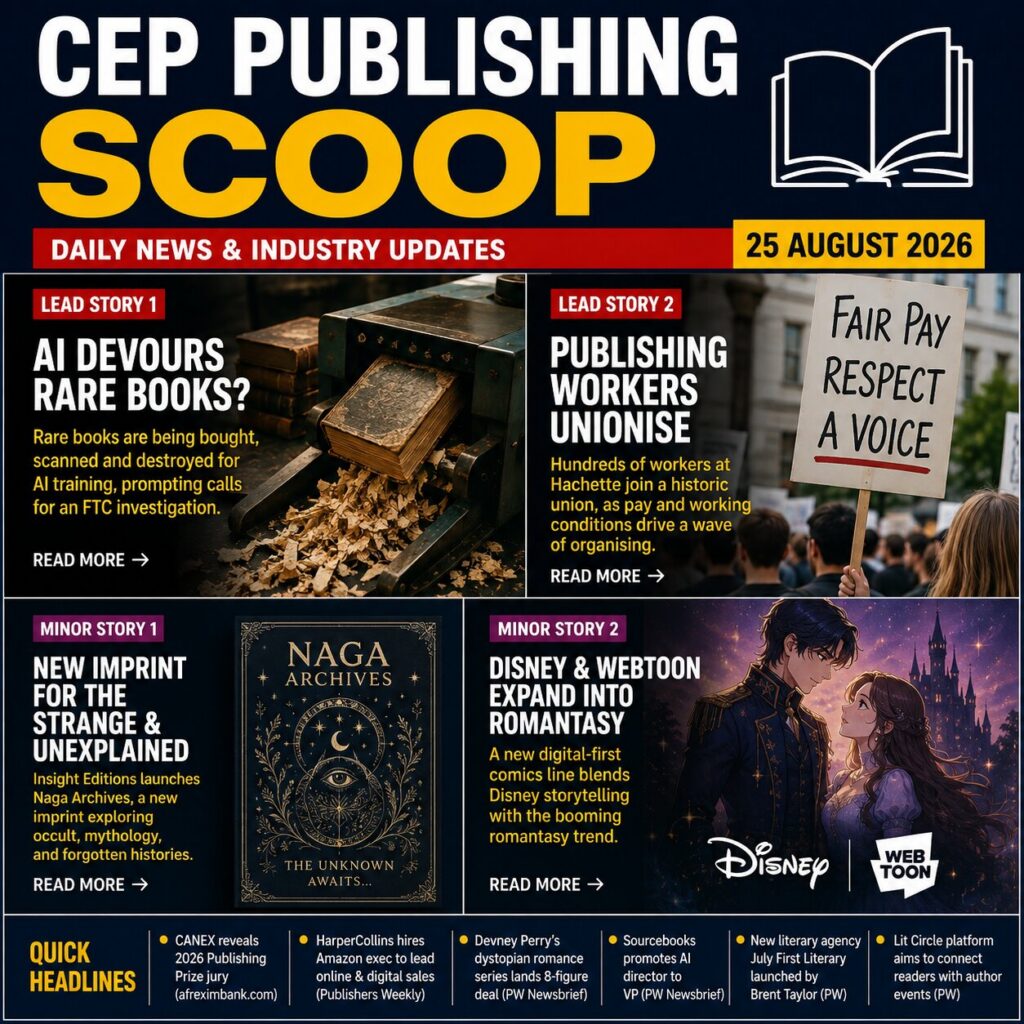
Welcome to the CEP Publishing Scoop for 25 August 2026, our quick look at some of the biggest developments moving through the international publishing and book industry.
Today, artificial intelligence is once again colliding with the book world, but this time the debate goes beyond copyright and into the physical destruction of books themselves. Meanwhile, publishing workers are increasingly organising over salaries and working conditions, a new imprint is embracing the strange and unexplained, and Disney is taking another step towards digital-first comics.
Lead News: Rare Books Are Reportedly Being Bought, Scanned and Destroyed for AI
The relationship between artificial intelligence companies and the publishing industry has taken another controversial turn, with reports that bulk buyers are purchasing physical books that may subsequently be scanned and destroyed for AI training.
Rare-book dealers have reportedly encountered unusually large orders for obscure and scholarly titles, sometimes involving hundreds of books purchased without the price negotiations typically associated with the trade.
According to reporting by The Wall Street Journal, some sellers have attempted to trace where these purchases ultimately go, with evidence suggesting books are being sent to scanning operations and, afterwards, recycling facilities. The concern becomes considerably greater when the material involved is rare or potentially difficult to replace.
The issue has now attracted regulatory attention. More than a dozen civil-society organisations have reportedly called on the US Federal Trade Commission to investigate AI companies acquiring, scanning and destroying books. Their argument extends beyond copyright: destroying source material after digitisation could potentially affect competition by making that material unavailable to others.
For publishers and authors, the controversy represents another chapter in the increasingly complicated relationship between books and generative AI. Debates surrounding training data have largely focused on whether copyrighted works can legally be used to train models. The destruction of physical books introduces an entirely different question concerning preservation.
Read The Wall Street Journal report
Read more about the call for an FTC investigation at Axios
Lead News: Publishing’s Union Movement Continues to Grow
A wave of successful unionisation efforts is reshaping conversations about employment within the US publishing industry.
Around 600 workers at Hachette Book Group recently joined the Washington-Baltimore News Guild, creating what Publishers Weekly describes as the largest trade publishing union in history. The development comes alongside organising efforts at Catapult Book Group, University of Chicago Press and Dark Horse Comics.
Workers across these organisations have raised remarkably similar concerns, including salaries, heavy workloads and limited opportunities for career advancement.
The situation is particularly significant for younger publishing professionals. According to Publishers Weekly, the median salary among publishing workers with six years or less of industry experience who participated in its 2025 salary survey was $56,000. The publication calculated that as 15.6% below a living wage for the New York City metropolitan area.
Publishers themselves appear to be responding to some of the broader pressure surrounding compensation. Penguin Random House recently increased its starting salary from $51,000 to $55,000.
Whether the current organising momentum eventually spreads across more of the Big Five remains to be seen, but employment conditions are becoming an increasingly important part of the industry’s conversation.
Read Publishers Weekly’s full report
In Other News: Insight Editions Creates an Imprint for the Strange and Unexplained
Insight Editions is heading into considerably darker territory with the launch of Naga Archives, a new illustrated-book imprint devoted to subjects including mythology, occult art, unexplained phenomena, forgotten histories and macabre culture.
Former Abrams ComicArts publisher Rodolphe Lachat will serve as editorial director, with the imprint expected to publish between six and eight books annually.
Its first release arrives on 27 October with Brandon Hodge’s Supernatural Machines: The History of Spirit Communication Devices, exploring devices associated with attempts to communicate with the dead.
For publishers working within horror, supernatural fiction and unusual nonfiction niches, the launch provides another indication that specialised subjects can support dedicated publishing identities rather than simply individual titles.
Read the Naga Archives announcement
In Other News: Disney and Webtoon Expand into Romantasy
Disney is combining two major publishing trends — romantasy and digital comics — through a new collaboration with Webtoon.
The Disney Cursed Love line will initially appear as vertical-scroll webcomics before moving into print. It expands an existing multi-year agreement designed to bring around 100 comics from Disney, Marvel, Star Wars and 20th Century Studios properties to Webtoon.
More than 20 Disney comics have already made their way onto the platform.
The digital-first approach is particularly interesting from a publishing perspective. Rather than treating digital comics simply as electronic editions of existing print products, projects such as this allow publishers to build audiences digitally before subsequently introducing physical editions.
Read more at Publishers Weekly
Around the Publishing World
CANEX reveals its 2026 Publishing Prize jury — The CANEX Book Factory has announced the jury ahead of CANEX WKND in Lagos, continuing efforts to strengthen publishing and literary recognition across Africa. Read more
HarperCollins recruits Amazon executive — Scott Sanders, who led Amazon’s books vendor services team working with major publishers, will become HarperCollins US Trade’s VP for online and digital sales on 8 September. Read more
A major romance deal lands at Bramble — Devney Perry’s interconnected City of Saint dystopian romance series has been acquired in a four-book, eight-figure deal. Read more
Sourcebooks strengthens its AI leadership — Scott Eells has been promoted to vice president and director of AI and automation at the independent publisher. Read more
A new literary agency enters the market — Former Triada US vice president and executive agent Brent Taylor has launched July First Literary, specialising in commercial fiction. Read more
Book events are getting their own discovery platform — Former bookseller Rebecca George is rolling out Lit Circle, designed to connect readers with bookstores hosting touring authors. Read more