Author Scam Warning: Fake Publisher Emails Are Targeting Writers
 Shaun M Jooste
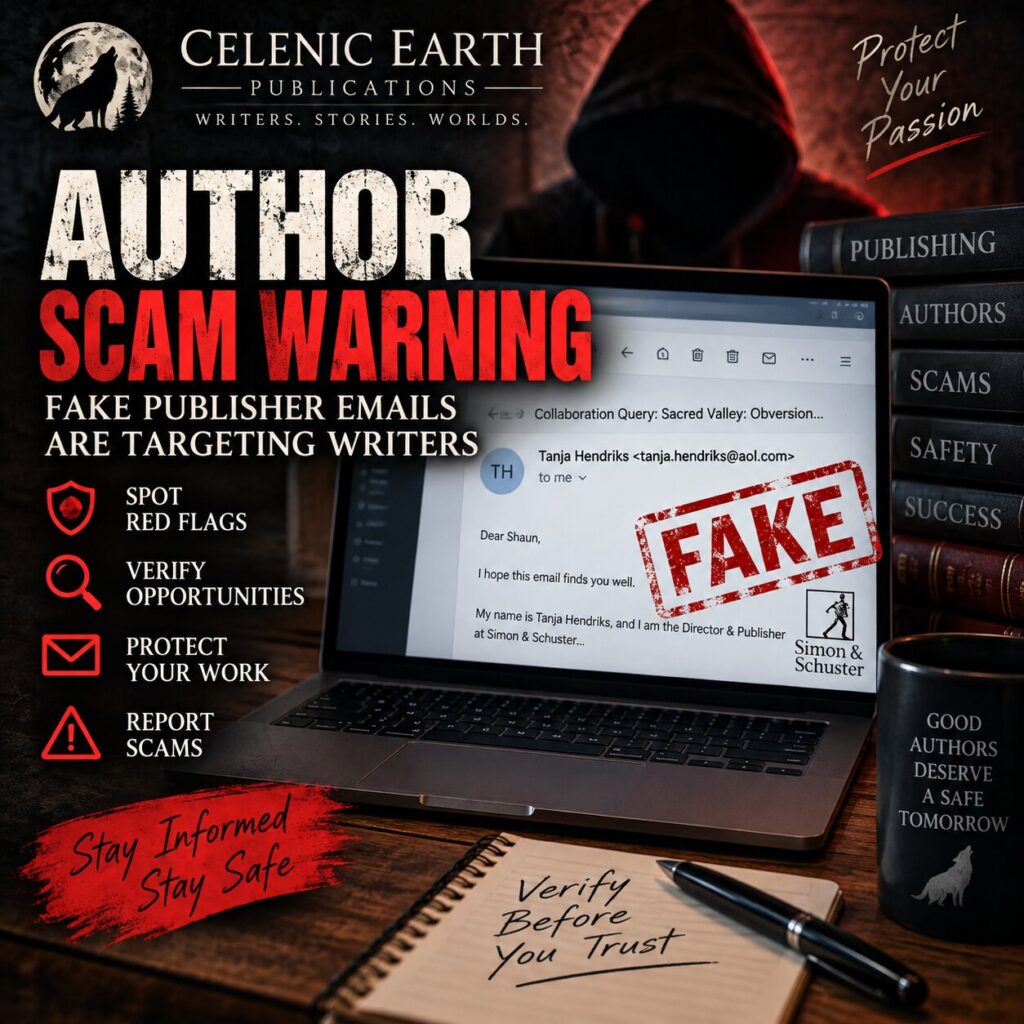
For authors, few emails are more exciting than one claiming that a major publishing company has discovered your work and wants to discuss a potential collaboration. Unfortunately, scammers know exactly how powerful that excitement can be.
Celenic Earth Publications recently encountered a convincing example firsthand. An unsolicited email claimed to come from a senior publishing representative at Simon & Schuster and expressed interest in Sacred Valley: Obversion, praising specific elements of the novel and suggesting discussions about future publishing opportunities.
There was only one problem: the email was fraudulent.
Rather than responding to the supposed publisher, we investigated the message and contacted the legitimate company. Simon & Schuster subsequently confirmed that the email was fraudulent and advised us to block and ignore the sender. The matter was also reported so that the appropriate fraud team could investigate it.
The experience provides an important reminder for authors, particularly independent writers hoping to attract traditional publishing opportunities: a professional-looking email is not proof that the person sending it is who they claim to be.
The Publishing Scam That Looked Surprisingly Convincing
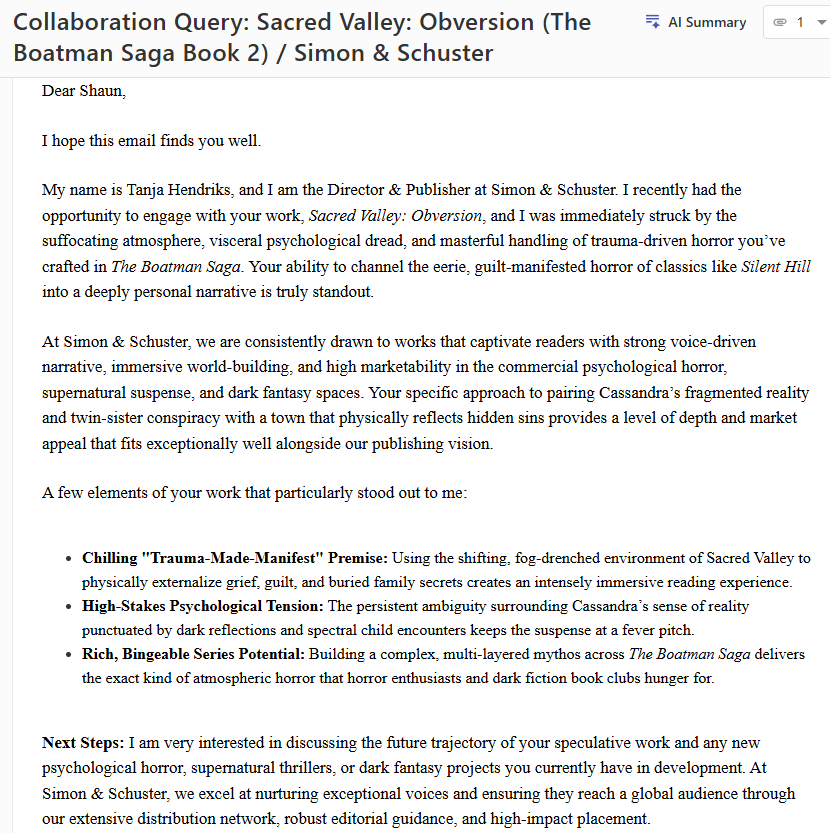
The fraudulent message was considerably more sophisticated than the stereotypical scam filled with spelling mistakes and vague promises.
Its sender claimed to be a director and publisher at Simon & Schuster and referred specifically to Sacred Valley: Obversion and The Boatman Saga. The message discussed elements of the novel, including its psychological horror, supernatural atmosphere and influences reminiscent of Silent Hill.
It even identified particular aspects supposedly attractive to the publisher, such as the series potential, psychological tension and the way Sacred Valley manifests characters’ trauma.
That degree of personalisation is precisely what can make modern scams dangerous.
Someone receiving an email that correctly identifies their novel, characters and themes may naturally assume the sender has genuinely researched their work. However, information about published books is readily available online, while modern generative tools can quickly produce detailed commentary based on book descriptions, reviews, websites and promotional material.
Personalisation should therefore never be treated as authentication.
The Biggest Warning Sign Was the Email Address
Despite the elaborate message, one detail immediately raised suspicion: the message had been sent from an AOL email account.
Someone claiming to represent a major international publisher should ordinarily be communicating through an appropriate corporate email domain. An unrelated free email service deserves immediate scrutiny, particularly when the sender claims to hold a senior position within the organisation.
The email also included an elaborate signature containing a photograph, company information, an official website address and social-media icons. Those additions may create an impression of legitimacy, but they prove very little. Logos, photographs, job titles, addresses and links can all be copied from legitimate websites.
Authors should therefore inspect where an email actually came from rather than judging its legitimacy by how professionally the message has been designed.
We Contacted the Real Company
Instead of using the contact information supplied by the suspicious sender, we approached Simon & Schuster independently.
Their response confirmed our suspicions. The company thanked us for bringing the fraudulent email to its attention and explicitly instructed us to block and ignore the individual impersonating its representative.
They also requested the original email’s full header, sometimes called its message source or raw message. Email headers contain technical information about how a message was transmitted and can help fraud investigators identify its actual origin.
The incident has therefore been reported through the appropriate channel, with the publisher looking into the fraudulent communication.
This is an important step that other authors can follow. If someone claims to represent a publisher, literary agency or other company and something feels suspicious, locate that organisation’s official website independently and contact it through a verified channel.
Warning Signs Authors Should Watch For
Publishing scams vary enormously. Some impersonate publishers or literary agents, while others promise representation, adaptations, marketing campaigns, book reviews or lucrative publishing contracts. The initial approach may even appear completely harmless before money or sensitive information is eventually requested.
Before responding to an unexpected publishing opportunity, check:
- The sender’s complete email address. Be suspicious when someone supposedly representing a major company uses Gmail, AOL, Yahoo or another unrelated domain.
- The company’s official staff information. A real person’s name can still be used by an impersonator, so finding that person online does not authenticate the sender.
- Where links actually lead. Displayed text can disguise a completely different destination.
- Whether the message creates urgency. Pressure to respond, pay or provide information quickly is a common manipulation technique.
- Requests for money or sensitive information. Never provide banking information, identification documents, passwords or payments before independently verifying who you are dealing with.
- The organisation itself. Contact the publisher or agency using details obtained independently from its official website.
Most importantly, do not verify a suspicious email using contact details contained inside that same email.
Successful Authors Can Become Attractive Targets
Writers sometimes assume publishing scams primarily target inexperienced authors. That is not necessarily the case.
An author with books already available online provides scammers with considerably more material to work with. Book descriptions, author biographies, reviews, interviews, social posts and series information can all be gathered to construct a highly personalised approach.
That creates a strange situation where an email can demonstrate detailed knowledge of your work while still being entirely fraudulent.
As artificial intelligence makes personalised messages easier to produce at scale, writers should increasingly separate two questions: Does this person know about my book? and Can I verify that this person actually represents the company they claim to represent?
Only the second question establishes credibility.
Don’t Let Excitement Override Verification
Receiving interest from a major publisher would understandably be exciting. That emotional reaction is exactly why impersonation scams can be effective.
There is nothing wrong with being thrilled when an opportunity arrives. Just verify it before acting on it.
In our case, an AOL address was enough to raise the alarm. Independent verification then established that the supposed Simon & Schuster representative was fraudulent, and reporting the incident gave the real company information that may help investigate the impersonation.
Authors work too hard building their books, careers and reputations to hand scammers an easy opportunity.
When a publisher comes knocking, celebrate the possibility—but verify who’s actually at the door.