CEP Publishing Scoop: Copyright, AI and a Publishing Industry in Transition
 Shaun M Jooste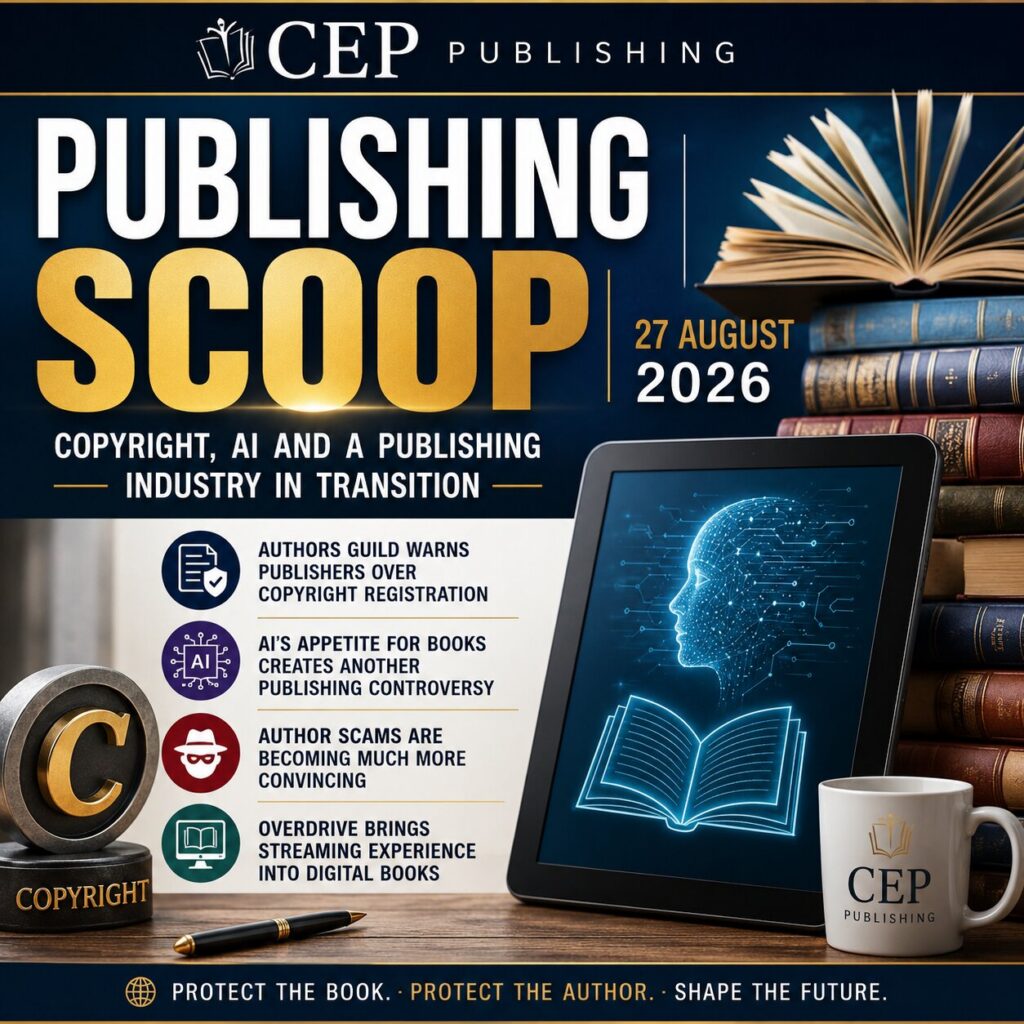
The publishing world rarely stands still, but the closing days of August have delivered several developments worth watching closely. Copyright protection is once again under scrutiny, artificial intelligence continues to challenge established publishing practices, increasingly sophisticated scams are targeting authors, and digital reading platforms are positioning themselves for their next stage of growth.
For authors, publishers and readers alike, the common thread is becoming increasingly clear: knowing who controls a book, how it is protected and where it travels after publication matters more than ever.
Authors Guild Warns Publishers Over Copyright Registration
One of the most important publishing developments this week concerns something authors may assume happens automatically: the proper registration of their copyright.
The Authors Guild revealed on 20 August that a survey conducted following the $1.5 billion Anthropic copyright class-action settlement uncovered cases in which publishers apparently failed to register authors’ books with the US Copyright Office, despite some publishing agreements placing that responsibility on the publisher.
According to the Guild, some affected authors subsequently discovered that their works were ineligible for the settlement.
The organisation had already updated its Model Trade Book Contract on 19 August, introducing clearer language around a publisher’s responsibility to register copyright. The proposed clause also gives authors an opportunity to act if their publisher fails to complete registration within the relevant timeframe.
For authors, there is a valuable lesson here that extends well beyond the United States: never assume contractual protections have been implemented simply because they appear in an agreement.
Writers should understand what rights they retain, what responsibilities their publisher assumes and what documentation exists to demonstrate ownership and registration where applicable.
AI’s Appetite for Books Creates Another Publishing Controversy
Artificial intelligence remains impossible for the publishing industry to ignore.
A particularly unusual controversy has emerged around physical books allegedly being purchased in large quantities for AI training purposes. Reports have raised concerns that books may be destructively scanned before being discarded or recycled, allowing their contents to become machine-readable training material.
The situation has now moved beyond copyright arguments alone. Civil society organisations have reportedly called on the US Federal Trade Commission to investigate whether large-scale acquisition and destruction of books for AI training could raise competition concerns.
For publishing, this represents another chapter in an increasingly complicated relationship with generative AI.
The question is no longer merely whether AI can produce text. Publishers, authors and regulators are now grappling with where training material originates, whether creators should be compensated, how copyright applies and what happens when physical copies become raw material for enormous datasets.
Whatever the eventual regulatory outcome, books have clearly become extremely valuable commodities in the development of artificial intelligence — sometimes in ways their authors never anticipated.
Author Scams Are Becoming Much More Convincing
Authors also have another threat to watch.
The Authors Guild issued a warning on 20 August regarding increasingly believable impersonation scams. Fraudsters are reportedly posing as legitimate book clubs, reviewers, television personalities and film producers when approaching writers.
Some scammers have even impersonated well-known personalities such as Reese Witherspoon.
Perhaps more concerning is the changing strategy. Rather than immediately demanding payment — an obvious warning sign — scammers may establish contact and build credibility before eventually requesting hundreds or even thousands of dollars for supposed appearances, promotions or opportunities.
Authors should remain cautious when receiving unexpected approaches involving:
- Book clubs, reviewers or influencers offering unusual promotional opportunities
- Film or television adaptation approaches that cannot be independently verified
- Requests for payment before interviews or appearances
- People claiming to represent celebrities or major organisations
- Publishing and marketing offers using suspicious email addresses
An exciting email telling an author that somebody wants to turn their novel into a movie is precisely the kind of message capable of lowering someone’s guard.
Verify first. Celebrate afterwards.
OverDrive Brings Streaming Experience Into Digital Books
Meanwhile, the technology behind digital reading continues evolving.
OverDrive announced on 25 August that Liz Carrasco has been appointed its new Chief Technology Officer. Carrasco brings more than two decades of technology leadership experience in digital media and streaming and will oversee the company’s global technology strategy and engineering organisation.
That becomes particularly interesting considering the scale of the platforms involved. OverDrive operates the technology behind Libby, Sora and Kanopy, connecting readers, students and library users with digital books and media.
Experience in personalisation and large-scale streaming could therefore have implications for how readers discover and interact with digital content in future.
For publishers and independent authors, digital distribution is no longer simply about producing an EPUB alongside a paperback. Discovery systems, library platforms, recommendation technology and digital ecosystems increasingly influence which books reach readers.
Around the Publishing World
Elsewhere in publishing, HarperCollins has launched Kazé, a new English-language imprint dedicated to manga, manhwa and manhua, demonstrating the continuing international expansion of illustrated storytelling.
Virginia Evans’ The Correspondent has returned to the top of the Independent Bookshop Top 20 for an eighth time, while publishers continue announcing multi-book acquisitions across fantasy, romance and other commercially strong genres.
The Authors Guild is also encouraging writers to think differently about book metadata. With readers increasingly asking AI-powered search systems highly specific questions when seeking recommendations, detailed metadata could become even more important to book discovery.
A reader may no longer simply search for “fantasy novels”. They might ask for a dark fantasy novel involving a reluctant hero, political betrayal and an unusual magic system.
The books whose digital information communicates those characteristics effectively may have an advantage.
That is a development independent publishers and authors should watch carefully.
The CEP View: Protect the Book, Protect the Author
This week’s stories collectively demonstrate why modern publishing requires far more than placing words between two covers.
Authors need to understand their contracts. Publishers need to protect the works entrusted to them. Everyone in the industry needs to remain alert to scams, changing technology, copyright developments and new methods of discovering books.
Artificial intelligence will continue changing parts of publishing. Digital distribution will continue expanding. New genres and international storytelling traditions will continue finding global audiences.
But one principle should remain remarkably simple.
The author’s work has value.
Protecting that value — legally, commercially and creatively — should remain at the heart of responsible publishing.